



Each week the Advertiser's history writer David Borrett brings readers interesting news stories and letters from editions of the paper from years gone by.
ONE HUNDRED AND SIXTY-FOUR YEARS AGO – FRIDAY 4 APRIL 1862
STEALING A DUCK
Two juveniles named Edward Cook and Thomas Glass, both of Andover, were summoned for having feloniously stolen and carried away on 25 March, at Upper Clatford, one duck of the value of 2s, the property of Mrs Guyatt.

Henry Spackman deposed: I am a draper’s assistant and reside in Andover.
On Tuesday 25th, between 1 and 2 o’clock, I was walking down by the side of the Andover canal when I overtook a man called Henry Webb – he called my attention to the two prisoners, and ran across a field and overtook them.
They were coming up Mead Hedges in the direction of Andover from Clatford.
I saw him take a duck from the prisoner Glass.
Webb asked the boys where they got the duck and they replied that they had found it by the side of the river.
We took the boys down to Mrs Guyatt’s, as Webb said he knew the duck belonged to her.
William Guyatt deposed: I am a farmer and reside at Upper Clatford.
The duck now produced is the property of my mother, Charlotte Guyatt.
We missed it on Thursday week last.
On Tuesday last, the two boys were brought down to my house by the last witness and a person called Webb, and they had the duck now produced.
I questioned the boys as to how they came by the duck, and they said they had killed and hidden it with two other boys on 19 March, near my farm.
They also said that they had come for it that day and that they were going to take it to a man at Andover who would give them 4d for it.
The magistrates sentenced both prisoners to be imprisoned for two days and to be once privately whipped.
ONE HUNDRED AND TWENTY-FIVE YEARS AGO – FRIDAY 5 APRIL 1901
ROBBING A LODGER

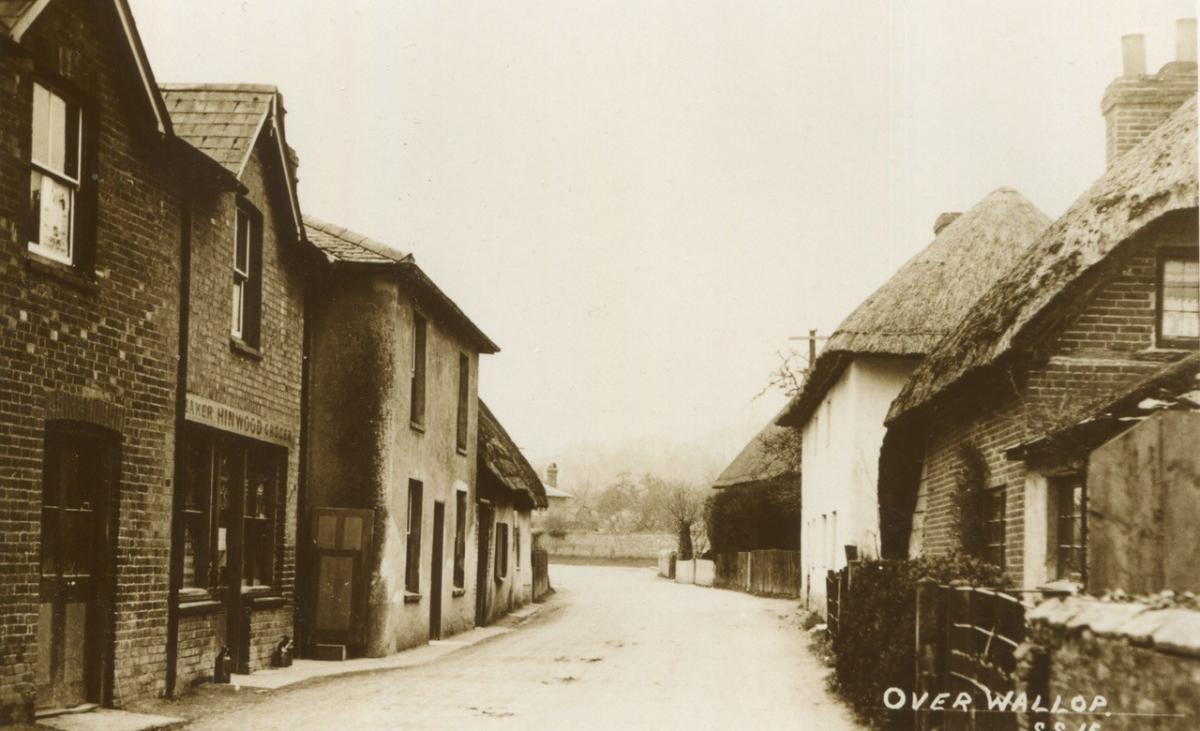
Kate Harman, married woman of Over Wallop, was brought up in custody charged with stealing £2 10s, the money of Harry Bracher, on 20 March.
Harry Bracher said he was a labourer working at Grateley station, and lodged with the prisoner at Over Wallop.
He had been in the habit of keeping his money in a box in his bedroom and he had £25 10s in the box which was not locked.
He saw the money safe on 17 March, when it was in a tobacco box inside his clothes box.
On 24 March, he missed a sovereign and three half-sovereigns and this was when he went to the police.
Prisoner had access to his room and he had lent prisoner 10s in silver on the 19th.
PC Oram, stationed at Nether Wallop, said that from information received, he saw the prisoner on the 25th at her house, and asked what money she had spent in the previous week.
She replied that she had none to spend, and he then asked her to account for the 10s in silver she had borrowed from Bracher and how she was able to change a half-sovereign at Hinwood’s shop.
She then admitted she went to Bracher’s box and took £2 10s in gold and was willing to give back all she had left which was £1 3s 7d.
PC Oram then arrested her and charged her with stealing the £2 10s.
After pleading guilty, the magistrates sent the prisoner to gaol for three weeks.
ONE HUNDRED YEARS AGO – FRIDAY 2 APRIL 1926
CORRESPONDENCE – OUR ROADS AND THEIR IMPROVEMENT
Sir: Your readers may like to know that the Ministry of Transport has recently made grants towards the cost of rural road schemes to the extent of about £300,000, and that next year the Treasury is increasing the grant to the Ministry of Transport for this purpose to about £750,000.
Every taxpayer as well as road users will be concerned to see that these grants are spent in the most practical and economic way.
I understand that the Ministry is making it a condition that any grant can only be used for schemes of definite improvement and not mere patching.
The grant will not exceed 50% of the expenditure, and where the improvement is temporary, it will be limited to 25%.
I think the Ministry of Transport would do better to insist that no grant should be given for patching or tar-spraying, which wears badly and is no lasting improvement.
Where re-surfacing is done, the grant should be contingent on the use of bituminous materials, which have proven enduring qualities.
As the rural authorities who will participate in these grants will not always have the requisite experience of road construction, it is all the more essential that the Ministry should lay down hard-and-fast rules for the sake of real economy.
Yours, Alfred W Yeo.
SEVENTY-FIVE YEARS AGO – FRIDAY 6 APRIL 1951
THIS WILL BE CENSUS WEEKEND
By today, every household in Andover will have received its form for filling out the 1951 census.
Heads of households are required by law to answer its 17 questions, and failure to do so will leave them liable to a fine not exceeding £10.
The issuing of the forms has been going on all week and many a housewife has opened the door to a soaked census enumerator who produces the form and asks, ‘How many rooms have you in this house?’
The enumerator fills in the answer and hands the form over.
Questions include, ‘How old are you?’ ‘What is your job?’ ‘Where were you born?’ and ‘Have you a water-closet?’
It is important that the completed form shows the exact state of the household on Sunday 8 April and everyone alive there at midnight must figure on it.
During the last 50 years there have only been four other censuses – in 1901, 1911, 1921 and 1931.
Because of the war, the 1941 census had to be abandoned.
It is interesting to note that between 1901 and 1931, the population of Hampshire increased by 400,000, to 1,102,770.
In a few weeks’ time, we shall know the current figure.
FORTY-SEVEN YEARS AGO – FRIDAY 6 APRIL 1979
BEER FESTIVAL GOES DRY AFTER SELL-OUT
The second Andover Beer Festival at the Sports Centre on Friday and Saturday proved to be an outstanding success – so much so that it almost ran out of beer.
Demand for the 25 different brews was so high that extra supplies of Bourne Valley Brewery’s Andover Ale had to be brought in towards the end of the Saturday session.
Both days were a sell-out, with more than 800 people visiting the exhibition, which specialised in the small breweries that have recently sprung up around the country.
Andover Ale proved to be the biggest seller but every ale was completely finished an hour before closing time on Saturday.
They included Ringwood Ale, Smiles Exhibition and Butcombe Bitter.
Considerable interest was caused by the presence of Penrhos Court Porter, the first porter to be brewed in Britain for decades.
Said one of the organisers, Andover brewer, James Lynch: ‘We followed the set standard of so much beer per person per hour but people drank double the national average.’


Share